
How Much Concrete Do I Need? A Simple Way to Work It Out
Ordering the right amount of concrete is one of the few jobs you cannot undo once the truck leaves. Order too little and the pour stops halfway, which leaves a weak joint and a rush fee for a second load. Order too much and you pay for material that ends up as waste. The good news is that the math is simple once you know the steps, and this guide walks you through all of it with real numbers you can check by hand.
Multiply length by width by thickness in feet, then divide by 27 to get cubic yards. For a fast result with no math, enter your measurements in the concrete slab calculator and it returns the volume, the number of bags, and the weight in seconds.
By the end you will be able to work out the volume for a slab, a footing, or a round form, turn that figure into bags or a ready mix order, and add the right amount of extra so you never come up short.
The Simple Formula for Concrete Volume
Concrete is sold two ways. Ready mix from a truck is sold by the cubic yard. Bagged concrete from a store is sold by the bag, rated by the volume each bag fills. So every estimate starts with one number, the volume of your pour, and then you turn that number into yards or bags.
Formula: Volume in cubic yards = (Length in feet × Width in feet × Thickness in feet) ÷ 27
The number 27 appears because one cubic yard holds 27 cubic feet. The one rule people get wrong is units. Length and width are usually in feet, but thickness is given in inches, so you must change the thickness to feet first by dividing it by 12. A four inch slab is 0.33 feet thick, not 4.
Once you have cubic feet, divide by 27 for cubic yards. That single figure is what a ready mix plant asks for, and it is also the starting point for counting bags.
How to Figure Concrete for a Slab, Step by Step
A slab is the most common pour, so it is the best place to learn the method. Follow these four steps and you can size a patio, a shed floor, a walkway, or a driveway.
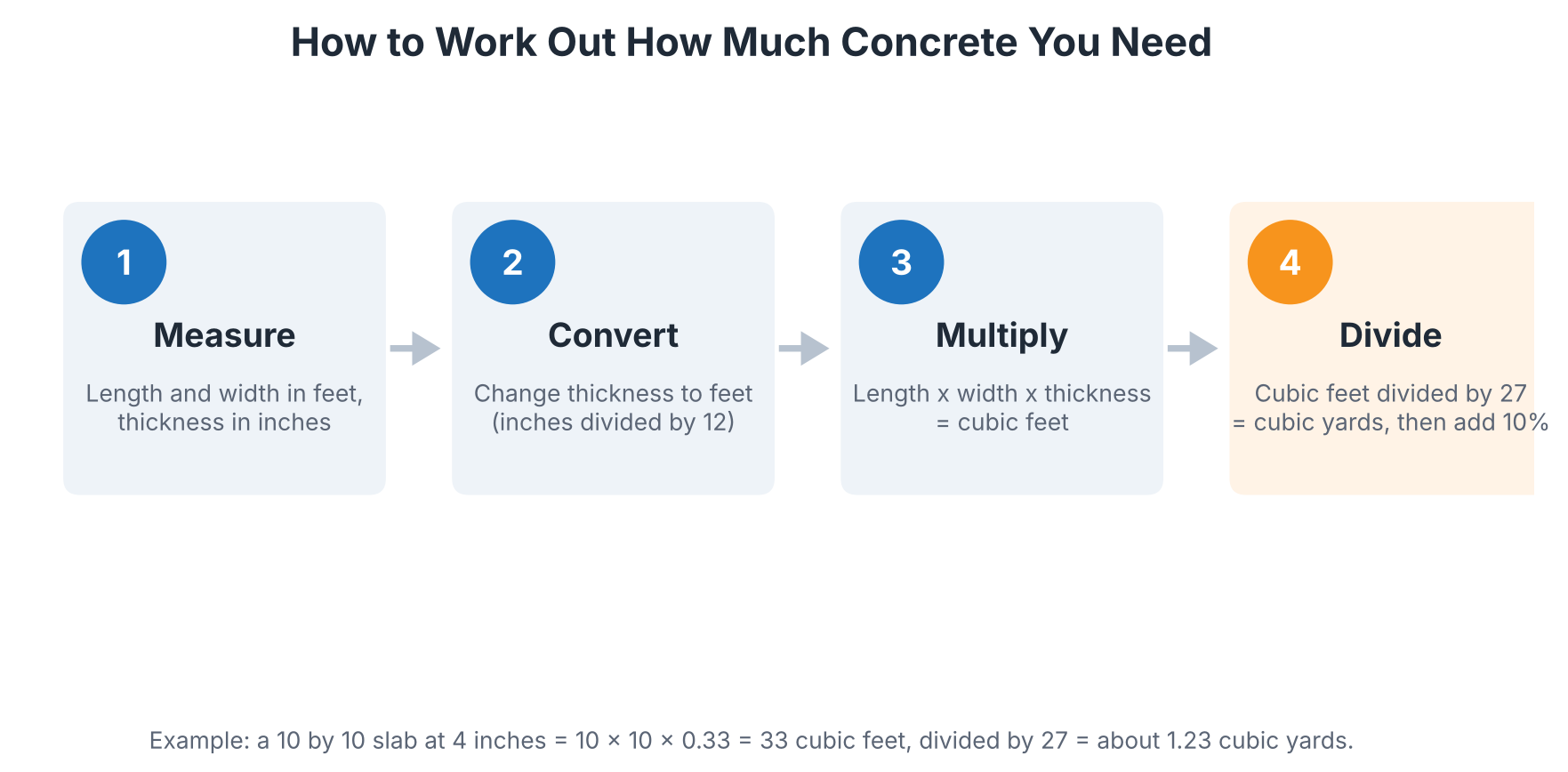
- Measure. Record the length and width in feet and the thickness in inches. A patio is usually 4 inches thick. A driveway that carries a car is 5 to 6 inches.
- Convert the thickness. Divide the thickness in inches by 12 to get feet. Four inches becomes 0.33 feet.
- Multiply. Length times width times thickness gives the volume in cubic feet.
- Divide by 27. This turns cubic feet into cubic yards, the unit a supplier uses.
Worked Example: a 10 by 10 Slab
Say you are pouring a 10 by 10 patio at 4 inches thick. First change the thickness: 4 divided by 12 is 0.33 feet. Then multiply: 10 times 10 times 0.33 equals 33 cubic feet. Divide by 27 and you get about 1.23 cubic yards. That same slab takes roughly 56 bags of 80 pound concrete. If you raise the thickness to 6 inches, the volume climbs to about 1.85 cubic yards, which shows how much thickness drives the total.
Common Slab Sizes at a Glance
Use this table as a quick check against any figure you work out. All volumes are for a 4 inch slab and include no waste yet.
| Slab size (ft) | Square feet | Cubic yards (4 in) | 80 lb bags | Bags or truck |
|---|---|---|---|---|
| 8 by 8 | 64 | 0.79 | 36 | Bags |
| 10 by 10 | 100 | 1.23 | 56 | Bags or truck |
| 10 by 12 | 120 | 1.48 | 67 | Bags or truck |
| 12 by 12 | 144 | 1.78 | 80 | Truck |
| 16 by 20 | 320 | 3.95 | 178 | Truck |
| 20 by 20 | 400 | 4.94 | 223 | Truck |
There is also a fast shortcut for a 4 inch slab. Divide the total square feet by 81 and you get the cubic yards without the other steps. A 200 square foot pad works out to about 2.5 cubic yards. The concrete slab calculator does every step for you and also handles odd thicknesses.
How Many Bags of Concrete You Need
For a small job, bags are cheaper and easier than meeting a truck minimum. Each bag fills a set volume when mixed, so the bag count is just your total cubic feet divided by the yield of one bag. These are the standard yields and how many of each it takes to fill one cubic yard, which holds 27 cubic feet.
| Bag size | Yield per bag (cu ft) | Bags per cubic yard |
|---|---|---|
| 40 lb | 0.30 | 90 |
| 50 lb | 0.38 | 72 |
| 60 lb | 0.45 | 60 |
| 80 lb | 0.60 | 45 |
To count bags for your pour, take your volume in cubic feet and divide by the yield of the bag you plan to buy. A pour of 33 cubic feet needs about 55 bags of 80 pound mix, or 73 bags of 60 pound mix. Always round up to the next whole bag.
The chart below shows how the bag count climbs with slab size for an 80 pound bag at 4 inches thick. Past roughly one cubic yard, the pile of bags gets heavy enough that a truck starts to make more sense.
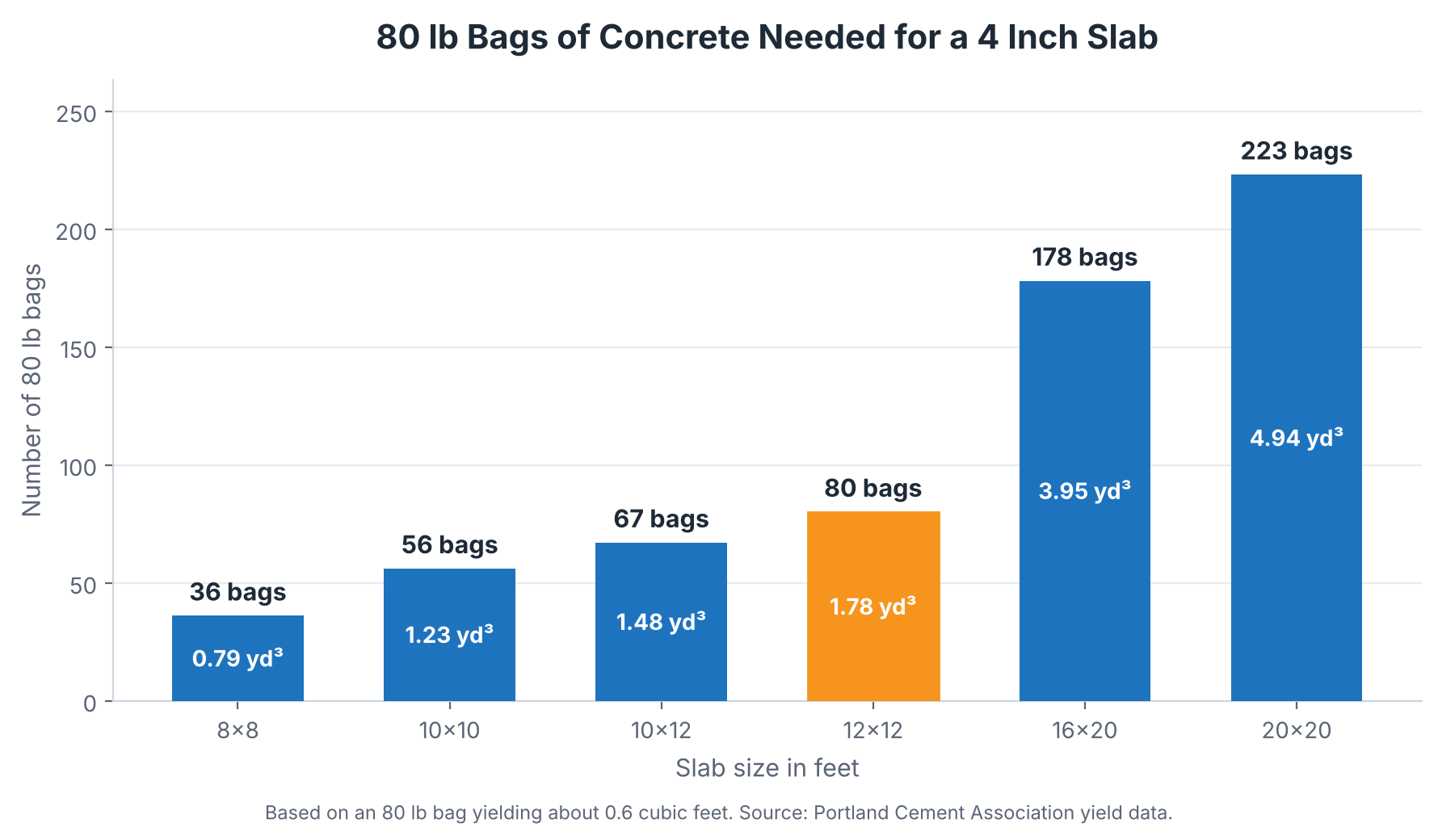
To skip the counting, the bags of concrete calculator gives you the exact number for any bag size and any project. Standard store brands such as Quikrete and Sakrete use the same yields, so the result works whatever brand you buy.
Concrete for Footings, Columns, and Round Forms
Not every pour is a flat rectangle. The same volume idea applies, but the shape changes the math.
Footings are long and narrow. Multiply the length by the width by the depth, all in feet, then divide by 27. A footing 40 feet long, 1.5 feet wide, and 1 foot deep holds 60 cubic feet, or about 2.22 cubic yards. The concrete footing calculator handles strip, pad, and continuous footings for you.
Round columns, piers, and sonotubes use the circle area times the height. The volume is 3.14 times the radius squared times the height. A 12 inch tube that is 4 feet deep holds about 3.14 cubic feet, close to 6 bags of 80 pound mix. The concrete column calculator works out round piers and tube forms without the hand math.
For steps, break the shape into parts. Treat the flat landing as a small slab and each step as a short footing, then add the volumes together. This keeps a tricky shape simple and accurate.
How to Work Out Concrete in Metric Units
Most of the world orders concrete in cubic meters, and the method is even cleaner because every measurement stays in meters. Multiply length by width by thickness in meters and the answer is already in cubic meters. No division by 27 is needed.
Say you pour a slab 4 meters long, 3 meters wide, and 100 millimeters thick. Change the thickness to meters first, so 100 millimeters becomes 0.1 meters. Then multiply: 4 times 3 times 0.1 equals 1.2 cubic meters. If you want that figure in cubic yards instead, multiply by 1.308, which gives about 1.57 cubic yards. One cubic meter equals about 1.308 cubic yards, and one cubic yard equals about 0.765 cubic meters.
Always Add a Waste Allowance
Never order the exact figure you calculate. The ground is never perfectly level, forms bend a little, and some concrete sticks in the chute and the wheelbarrow. A small shortfall can stop a pour, so a modest cushion protects the job.
The adjustment is easy. Multiply your volume by 1.1 to add 10 percent. For a clean, well formed pour on stable ground, 5 to 10 percent is enough. For rough ground, hand dug footings, or odd shapes where the depth varies, use 10 to 15 percent. On a 2 cubic yard order, a 10 percent cushion adds about 0.2 of a yard, which costs far less than sending the truck back for a second trip.
Bags or Ready Mix: Which to Choose
The choice comes down to size. The practical crossover sits at about one cubic yard.
Below one cubic yard, bags usually win. They cost less for a small job, you mix only what you need, and there is no truck minimum to meet. A few fence posts, a small pad, or a short walkway are bag jobs.
Above one cubic yard, ready mix starts to win. One yard of 80 pound bags is 45 sacks, which is a long day of mixing. Two yards is 90 bags. At that point a truck is cheaper, faster, and more consistent because the plant batches the mix the same way every time. A ready mix plant can also work out the yardage for you from your square footage and thickness, so have those numbers ready when you call.
Quick Reference: Weight, Cost, and Thickness
Three numbers come up on almost every project. Keep them handy when you plan a pour and a budget.
| Factor | Figure to remember | Notes |
|---|---|---|
| Weight | About 4,050 lb per cubic yard | Standard mix at 150 lb per cubic foot, a touch over 2 tons |
| Cost | About 6.50 to 10.50 dollars per square foot | Plain slab, materials and labor, varies by region |
| Thickness, patios and walkways | 4 inches | Standard for foot traffic |
| Thickness, driveways and garage floors | 5 to 6 inches | Needed for vehicle loads |
| Thickness, heavy or commercial use | 6 inches or more | Usually with reinforcement |
Thickness has the biggest effect on both volume and cost, so set it to match the load rather than guessing. Moving a 400 square foot driveway from 4 inches to 6 inches raises the pour from about 4.9 to 7.4 cubic yards, which is half as much concrete again.
Frequently Asked Questions
How much concrete for a 10 by 10 slab?
A 10 by 10 slab at 4 inches thick needs about 1.23 cubic yards, which is close to 56 bags of 80 pound mix. At 6 inches thick it rises to about 1.85 cubic yards.
How much is a yard of concrete?
A cubic yard of ready mix concrete runs in the low hundreds of dollars in most areas before delivery, with prices set regionally. A quick call to two local plants gives you a firm number for your area.
How many bags of concrete make a yard?
It takes 45 bags of 80 pound mix, 60 bags of 60 pound mix, 72 bags of 50 pound mix, or 90 bags of 40 pound mix to fill one cubic yard.
How do I figure yards of concrete?
Multiply length by width by thickness with every measurement in feet, then divide by 27. For a 4 inch slab you can also divide the square footage by 81 to get cubic yards.
How many cubic feet is an 80 pound bag of concrete?
One 80 pound bag of concrete yields about 0.6 cubic feet of mixed concrete. A 60 pound bag yields about 0.45 cubic feet.
How much does a yard of concrete weigh?
Standard concrete weighs about 4,050 pounds per cubic yard, which is just over 2 tons. That figure matters for what your trailer or truck can carry.
Should I buy bags or order ready mix?
For jobs under one cubic yard, bags are usually cheaper and simpler. For larger pours, ready mix from a truck is cheaper, faster, and more consistent.
How much extra concrete should I order?
Add about 10 percent for waste on a normal pour. Use 10 to 15 percent for rough ground or hand dug footings where the depth varies.
Related Guides and Next Steps
Now you can size any pour, turn it into bags or yards, and add the right cushion. When you want the answer in seconds, let a tool do the arithmetic.
- Size a floor or pad with the concrete slab calculator
- Count sacks fast with the bags of concrete calculator
- Estimate strip and pad pours with the concrete footing calculator
- Work out piers and tubes with the concrete column calculator
- Learn the full method in our concrete calculation guide
References
Yield, weight, and strength figures in this guide follow published industry data. For deeper reading, see the Portland Cement Association and the National Ready Mixed Concrete Association.
Reviewed and published by the bestconcretecalculator.com team. Last reviewed November 2026. Figures are estimates for planning. Always confirm structural pours with a local engineer and your building code.